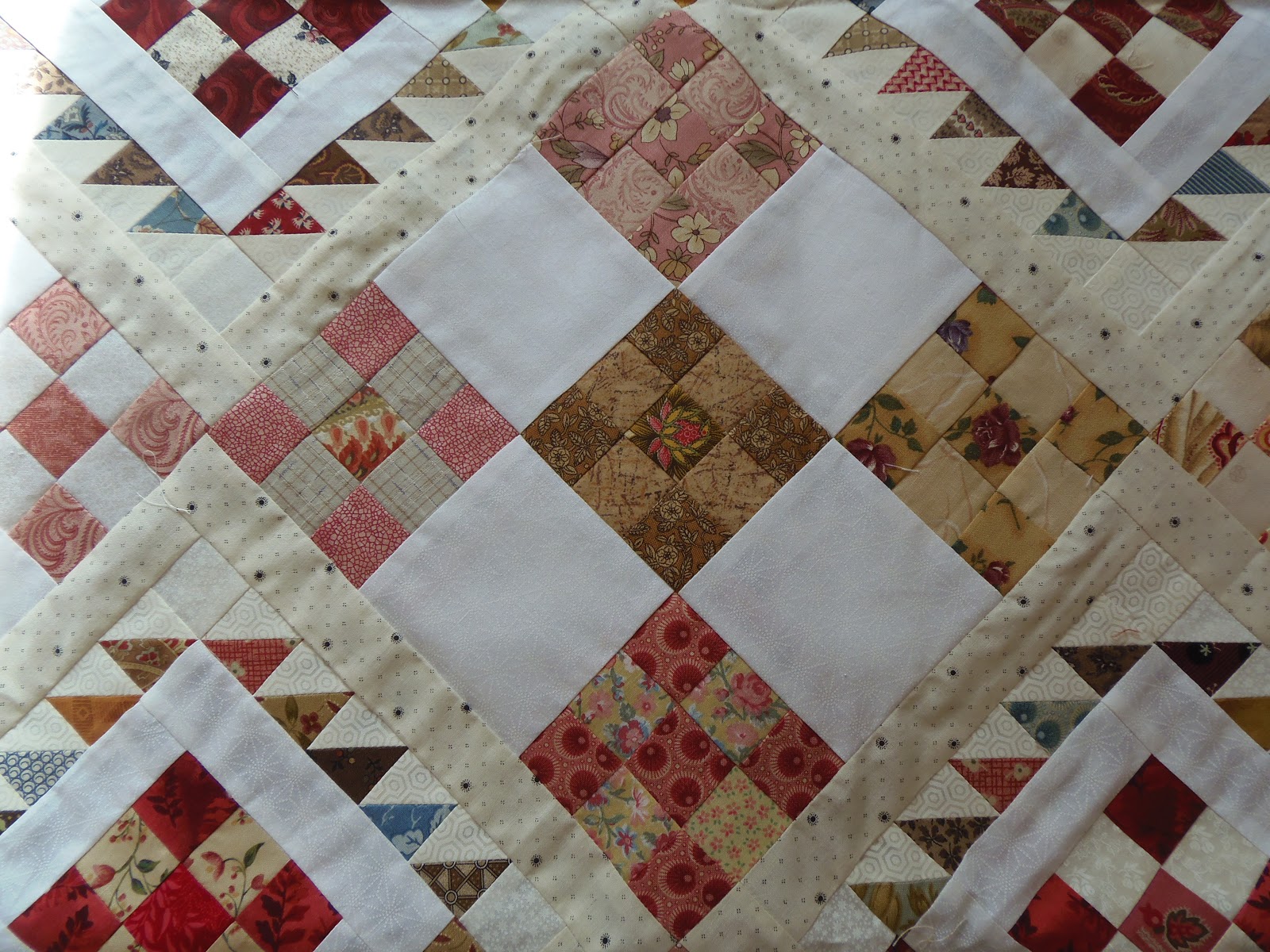
Orange Crush, 2013
For fun I snuck a little grasshopper in one of the blocks. I told her I did it but didn't tell her where I hid it so she had some fun exploring the quilt!

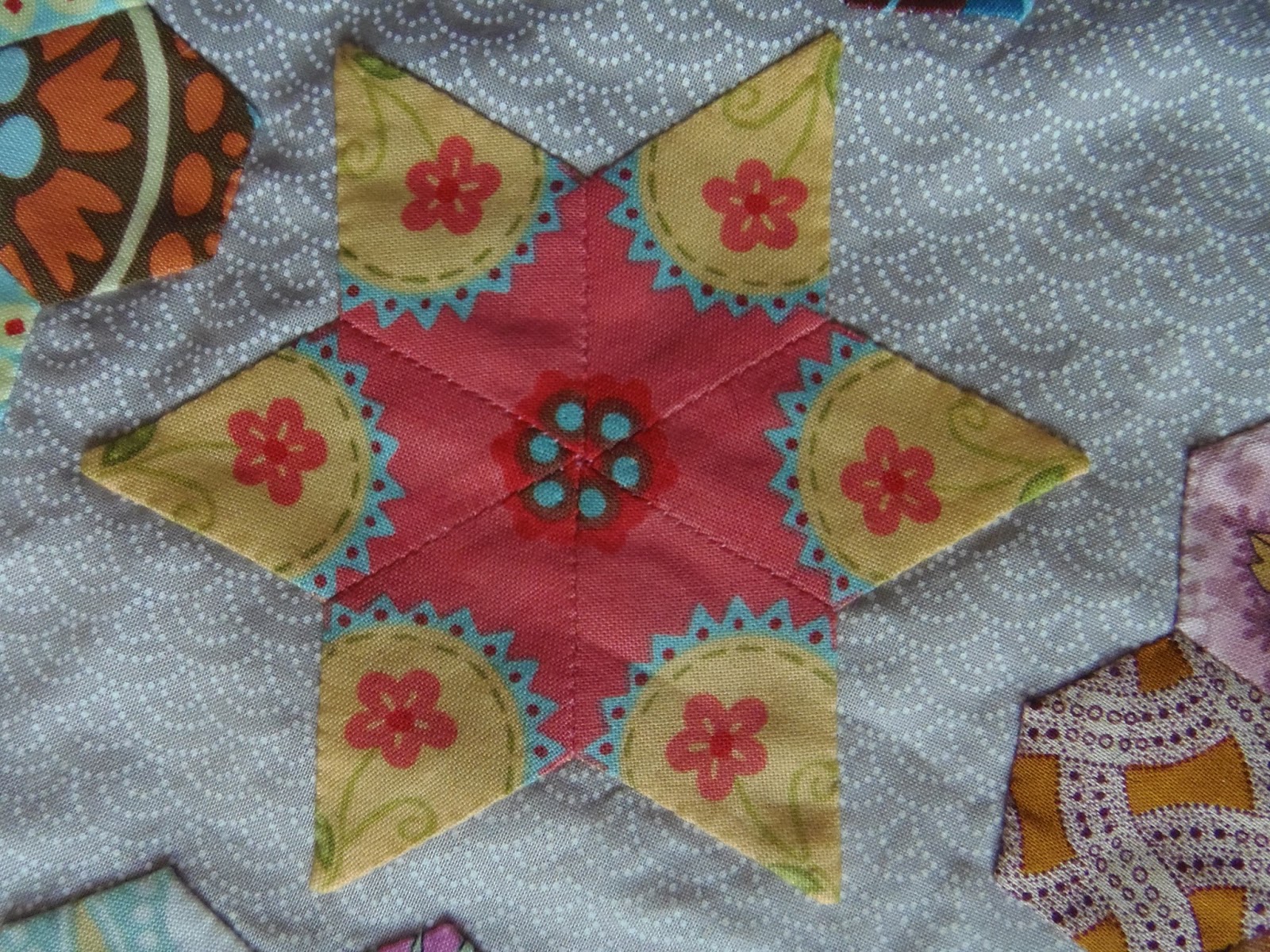
I promised to show you how I "fussy cut" the patches for my star blocks in Mom's Flower Bed. The quilt was made using the English paper piecing method.


To be technically correct they are not "fussy cut" but they have the appearance of being fussy cut. The following instructions are based upon using diamonds to make six point stars but you could also use hexagons or even squares. The process would be similar but not the same; for now I'll focus on diamonds.
To make the stars you will need the following:
- fabric,
- paper diamonds for English paper piecing,
- marking tool and
- a clear template (you can read more here).

When selecting the fabric it is important to look for the "repeat". The design is usually repeated along the raw edge and always along the selvedge edge. We will work with the repeat along the selvedge. In the following picture the selvedge edge is at the bottom. You will notice that there is a flower in the lower left corner. If you scan across the selvedge edge you will see that the same flower doesn't repeat until the lower right corner. The distance between is almost 12 1/2". I need six diamonds to make a star so I will need six repeats (12 1/2" x 6 = 75"). This means I will need 2 metres of fabric which is slightly over two yards. The greater the distance between the repeat the more fabric you will require and the shorter the distance the less fabric. However, if the distance too shorter the stars may not be as varied. I find that 8" to 12" is a good repeat to work with.

I cut strips of fabric that run parallel to the selvedge but before I do this I must determine the width of the strips to cut and to do that I need the diamond that will be used for English paper piecing. I measure the height of my diamond from parallel edge to parallel edge. In this case it measures 1 1/8”. For ease I round up to the nearest quarter of an inch which makes the measurement 1 1/4".

The paper diamond does not include seam allowances so they must be added (top and bottom) to the measurement. If I add 1 /2" to the 1 1/4" the width of the the strip will be 1 3/4”. With this method if you are a little more generous with the cutting it is better because it gives you a little wiggle room for adjustments. If I were just starting out I might be tempted to add another 1/8 to 1/4". I've already added 1/8" with the rounding up of the size of the paper template so I'll be fine with the 1 3/4" strip.
Preparing the fabric for cutting The first strip will be larger than the required 1 3/4" size because of the selvedge. Mine measures 1/2". This means the first strip will be cut at 2 1/4". All of the subsequent strips will be cut at 1 3/4". To prepare to cut the first strip I place my ruler so that the 2 1/4" mark lines up with the edge of the selvedge. I use a ruler that is longer than my repeat. Once the ruler is lined up on the selvedge I make sure that the top edge of the ruler hits the first motif and the repeat motif at the same spot as indicated by the red dots.

I draw a line on the fabric between the two motifs and a little beyond. I move the fabric along and once again line up my ruler on the selvedge making sure that the top of the rule lines up with the drawn line and that it hits the next repeat at the same point. I again draw a line. I repeat this step until I have a line drawn on the six repeats.
I now go back to the beginning and line up the 1 3/4" mark on my ruler on the drawn line. I draw a line making sure it hits the repeats in the same spot. I do this one or two more times.

I now am ready to cut my first strip. With sharp scissors I cut on the second line that I drew. If you prefer you can cut on the first line.
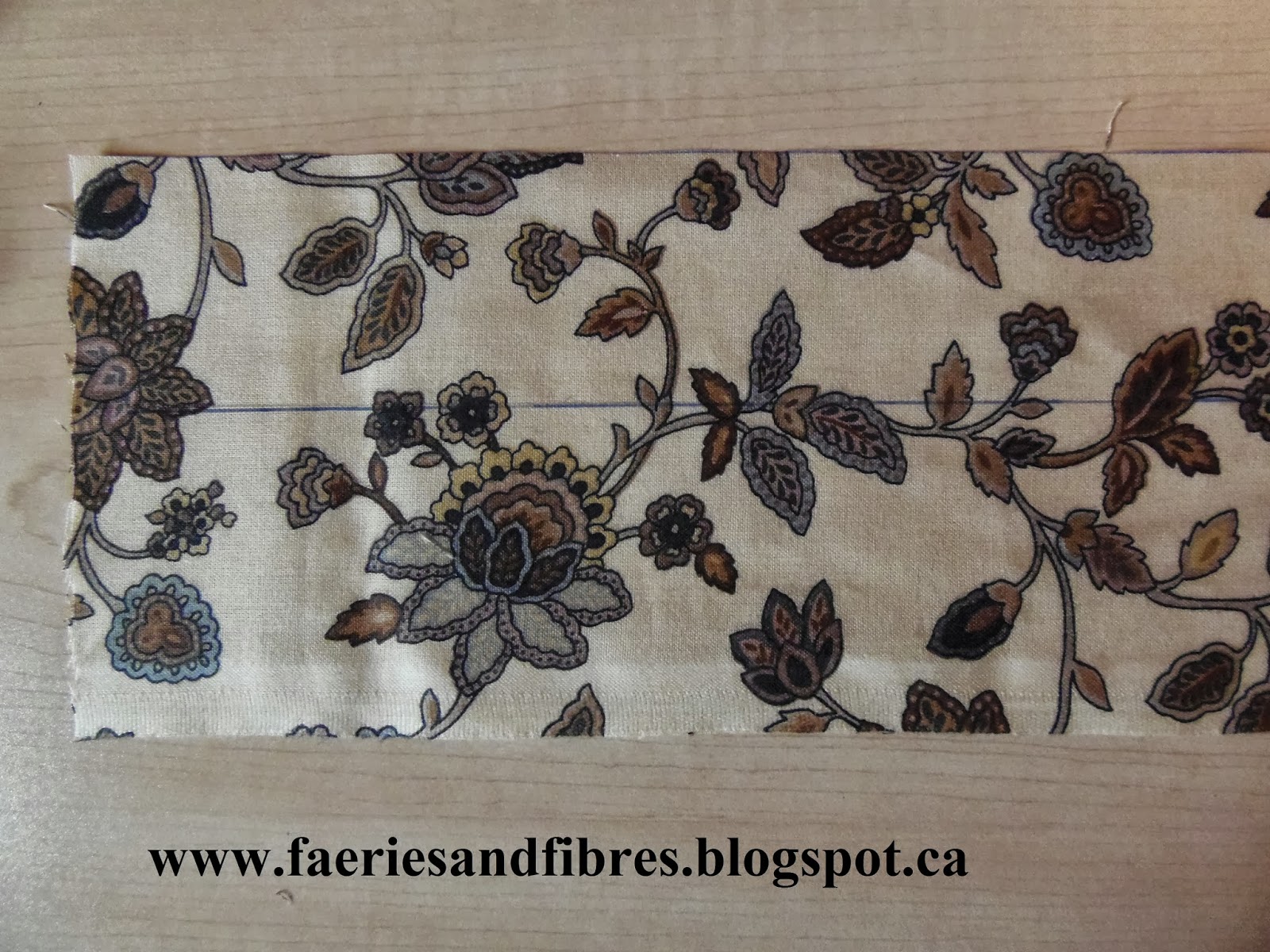
The next step is line up my ruler on the line at the 1 3/4" mark and trim the seam allowance away.

I cut this strip in half on the line with scissors or a rotary cutter.

I lay the left end of my strip on the cutting mat (it is in the centre) and find the beginning of the fourth repeat (at the bottom).

I place my clear template on the fourth repeat, draw a line and then cut on that line.


I line up the cut edge on the remaining strip lining up the print. I pin and cut.

I repeat this process until I have six strips.

I select one strip and with my clear template, I place it at the far left and draw a line. I move it to the right and draw another line. I repeat this right to the end of the strip. In the photograph below I have drawn all of the cutting lines on the strip.


I now have several sets of diamonds.

And this is what some of the first star looks like!

When the points are moved to the centre we have an entirely different star!

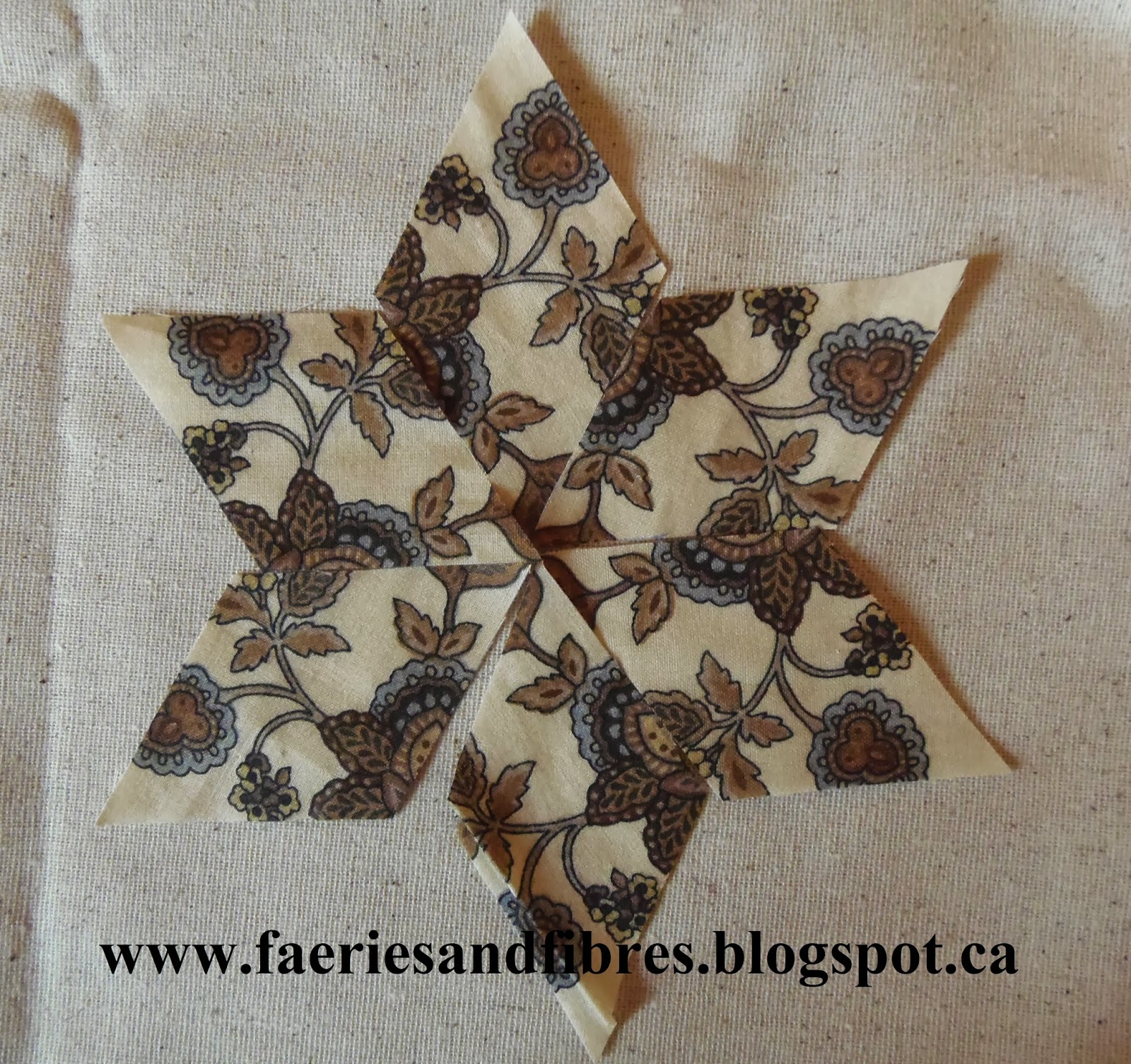
And when the points are moved to the centre we have yet another star!

The third set of diamonds yields this star!
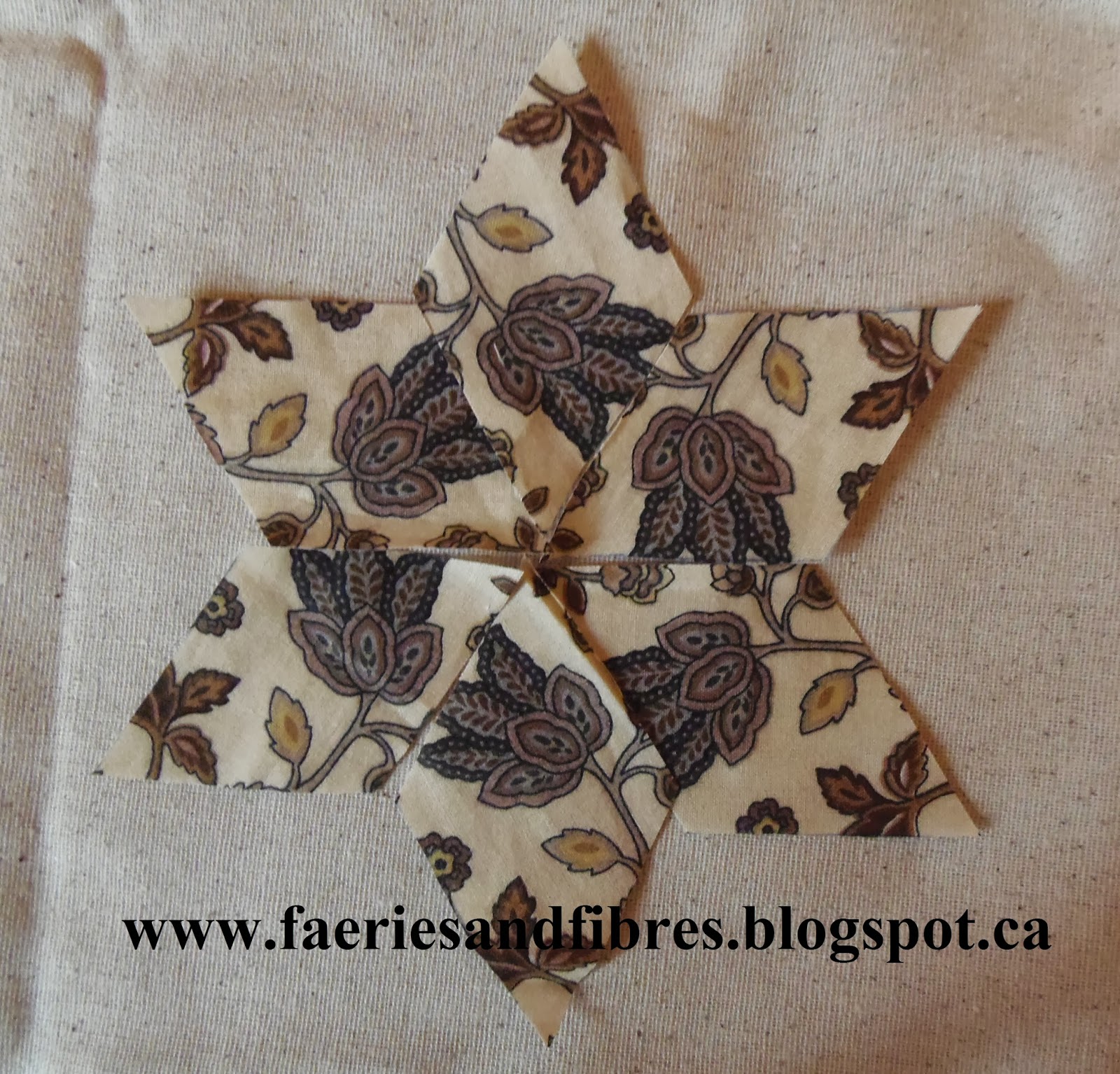
Again when the points are moved to the centre a new star emerges!

The stars will look a little different when they are basted and stitched together but you get the general idea!
I draft my own diamonds (amazingly easy if you have a sheet of graph paper, or lined/ruled paper, a mechanical pencil and an Omnigrid ruler with a 60o angle marking). I'll show you how in an upcoming post!
Phew! This was a long post. Time for a cup of tea and maybe some sewing! So until I post again, happy sewing!