

There are lots of hexagons to baste for this round and for the next round. I always have a small bag of hexagons for basting in my purse. Every time I have a few spare minutes I haul it out and baste. You would be amazed how quickly the job gets done when you make use of those minutes. Here you can see some of the hexagons for the next round basted.

Those little sewing scissors stay in my sewing bag (upper left corner) as does a small spool of thread. I save my empty spools of Gutermann thread and wind my inexpensive polyester basting thread on them. You can see that the spool above is almost empty so it is time to fill another with basting thread! I like to baste from the back and that means the basting thread will remain in my quilt. For this reason I prefer to use a light colour basting thread because it works on all colours of fabric whereas a dark thread may show through a light colour fabric.

As to how many hexagons I need for the next round of the diamond, each round increases the number of hexagons needed by eight. I chose to use a piece of fabric in the middle of the diamond rather than hexagons but had I used hexagons there would have been 8 of them (excluding the hexagon in the middle). The first round of hexagons is made up of 16 hexagons. The pale cream is 24, the yellow is 32, the dot fabric round is 40 and the latest round of grey blue is 48. The next round is going to be a deep honey gold and I'll need 56. There are two diamonds so that is a total of 112 hexagons to baste!
If I were making a traditional flower or rosette of hexagons I would start off with 6 hexagons (excluding the middle hexagon). The number of hexagons required increases by 6 for each additional round so there are 12 hexagons in the second round.

If you are using a directional print as in the block above here's a bit of helpful information. It is the flat edge of a hexagon that radiates out in the first round of hexagons. In the second round the flat edge of the six hexagons radiate out and the second six radiate out from point to point. This means that you will have to cut the hexagons differently to ensure that the print is always moving in the same direction.
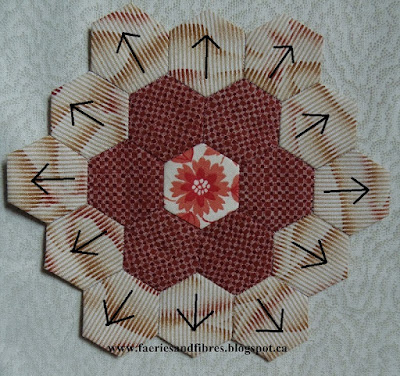
If there were a third round of 18 hexagons, the flat edge of six would radiate out and the pointy bits of the remaining 12 would radiate out.
Enough talking. Time for me to brew a cuppa and do some basting/sewing! Until I post again, happy sewing!
Karen H
