There have been several questions about how I made my quilt
81 The Giant Monstrosity. Some were from no-reply bloggers which means I can't reply to the comment or question. I reply to every comment so if you don't hear from me it means you are a no-reply blogger and I have no way to contact you unless you provide me with your email address. Anyhoooo, I thought I would answer the questions here!
Where did I get the pattern for 81 The Giant Monstrosity?
I made my own pattern. I saw pictures of the original quilt (below) which was made in the 1800s. I fell in love with it (what lover of hexagons wouldn't) and I drafted my own pattern. This is the original quilt.
This is my version before I added my final diamond border. I made mine in brighter colours. The grey fabric in the centre panel is different from the grey in the border and that's just fine.
I started with the centre panel for my quilt. It is a single piece of fabric with 81 hexagon rosettes and stars. I determined the measurements for the borders as I went along. I did make some changes to my version of the quilt. For example I swapped out the pieced blocks in the corners for appliqued baskets and I added a slightly different diamond border. While I drafted my own pattern there is a commercial pattern available for this quilt from
Threadbear. The Threadbear pattern is by Corliss Searcey and her version of the quilt measures 72" x 82". My quilt measures 92" by 97". I believe the title of her pattern is
English Basket Quilt.
What size are the hexagons and diamonds?
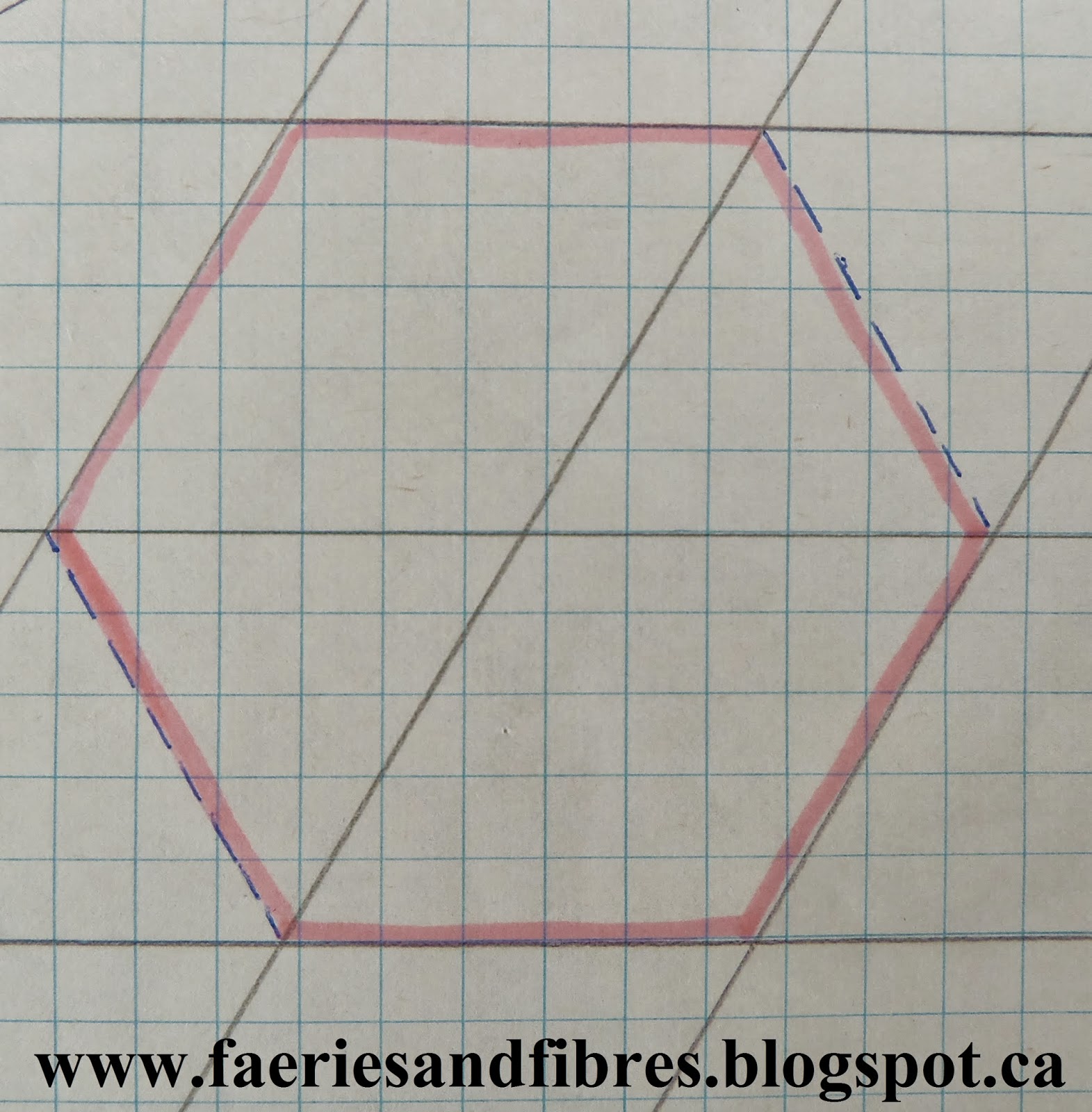
I used 3/4" hexagons. You will find the template I used for my hexagons
here. Each side of the diamond measures 1 1/4". I drafted my own diamond master template, made copies and cut them up as I needed them. I explained how I draft them
here.
Are the hexagon rosettes and stars appliqued?
Yes. After the stars and rosettes were stitched I gave them a spritz of starch and pressed with a hot dry iron. The basting threads and papers were removed and I used Roxanne Glue-Baste-It to affix them to the background for applique.
When I thread baste my diamonds I do the corners a little differently. The method I use results in diamonds that look like the diamond on the left in this picture. You can read how I do this
here. I makes the applique much easier because there are no dog ears to be tucked in!
What kind of paper do I use for the hexagons?
I just use regular 20lb bond printer paper and don't seem to have problems. You can get printer paper that is a little heavier but not quite as heavy as cardstock and that might be a better option for you or you can use cardstock. I use a glue stick to tack my papers to my fabric (a tiny dab of glue is applied to the paper never the fabric) and I use only enough glue to hold the paper in place on the fabric so when it comes time to remove the paper the bond is very weak and in most instances the paper just pops out. If you prefer not to use a glue stick another option (which I've used for 1/2" hexagons) is to use applique pins. They are very tiny and unobtrusive so your thread won't get tangled around them when you baste.
Are the papers reusable?
Sometimes. If the paper is in good shape I will reuse it. Otherwise it goes in the recycling box. In order to be reusable I want nice sharp corners so if the paper is chewed up at the corners I get rid of it!
What basting method do I use?
In the past I basted through the fabric (the brown hexagons in the picture below) and will continue to do so when making my foundation paper pieced English paper piecing hexagons. However when as of late I've been basting only the fabric at each corner fold without piercing the paper (the turquoise hexagons in the picture below). With this method the basting thread remains in the quilt and the papers just pop out quite easily. The bonus is that the papers remain relatively intact which means most of them can be reused. Let me know if you would like a little tutorial!
There is an alternative to thread basting and it involves the use of starch and freezer paper. Missie of
Traditional Primitives explained her method and you can read about it
here. I've tried this method and it works really well. There are no threads or papers to removed however you will need a little iron such as
Clover's Mini Iron or
Dritz's Petite Press for this method.
If you have questions about the making of
81 please feel free to send me an email or leave me a comment and I'll be more than happy to reply. It's time for me to get back to quilting
81. Until I post again, happy sewing!
Karen H